




(The Center Square) – The months leading up to the November elections have been fraught with questions about voter security and ballot secrecy but officials say they expect the election to go smoothly.
Most everything is the same as the primary process in May and June, with the exception of the early voting start date, said Joseph Kirk, Bartow County’s election supervisor and immediate past president of the Georgia Association of Voter Registration and Election Officials. Early voting starts Tuesday.
“You won’t have to mark your ballot by hand unless you’re voting through the mail, provisionally, which has always been the case,” Kirk told The Center Square in a digital interview. “There is an additional requirement for us to keep a handwritten, numbered list of voters.”
That could be done in different ways, Kirk said.
“You might see one county with a poll worker writing the names down, another county asking voters to write the names down,” Kirk said. “It’s something I’ve done before and I don’t anticipate it slowing down the process a whole lot.”
Asked by The Center Square if the election will be secure, Secretary of State Brad Raffensperger said, “Absolutely. It always is.”
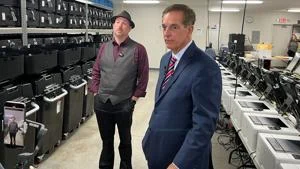
Along with Election Supervisor Kirk, Raffensperger spoke to reporters Tuesday – one week before early voting begins – during a demonstration of voting equipment testing, known as logic and accuracy testing, at the Bartow County Elections Office in Cartersville.
Some members of the State Election Board have said a software flaw in the Dominion system puts ballot secrecy at risk by letting others see how someone else voted.
Asked about those concerns, Raffensperger walked through the voting process.
“At the end of the day, we have a secret ballot,” the secretary of state said, motioning to election machines and a ballot box. “You are the voter. You show up, and you make your selections here. It prints it out, and those ballots are secure in this ballot box.
“When the polls close, then that’s when the tabulation is pressed. The ballots are then brought out, they’re secured and stored, because these have to be secured and stored for up to two years after an election.”
Kirk said Raffensperger’s office has put out guidance on how to ensure ballot secrecy isn’t compromised.
“We’re routing files through that office for disclosure, to be sure everything’s redacted properly,” Kirk said. “And with the exclusion of a few data points from the data we give out to the public, it’s not possible anymore.
“So we have mitigated that, and I’m comfortable with those mitigations. We’ll be looking at how to further mitigate in the future.”
The State Election Board passed a resolution on Sept. 30 asking for the federal government to urge Raffensperger to update voting machines before November and remove QR codes within six months. The Coalition for Good Governance, a Georgia election integrity advocacy organization, is asking the General Assembly to urge the Election Board to rescind that resolution.
“The board has handed the Trump administration a blank check for involvement in Georgia’s elections,” the organization said in a release. “Trump’s DOJ will most assuredly cash those checks. The danger extends beyond whether DOJ can obtain the particular remedies the letters demand.”
DOJ is an acronym for the Department of Justice.
Gubernatorial candidates Keisha Lance Bottoms and Rick Jackson said during Tuesday night’s debate they don’t think federal intervention is necessary in November’s election.
“I don’t think that’s necessary unless Governor Kemp thinks it is necessary,” Jackson said, referring to two-term Republican Gov. Brian Kemp. “I’m unaware of any reason that we need to have anybody do an investigation of this election.”
Bottoms said that if elected, she would eliminate the State Election Board that has “gone rogue and has been a disaster for the state of Georgia.”
“I am deeply concerned about Donald Trump’s rhetoric around our elections,” Bottoms said.